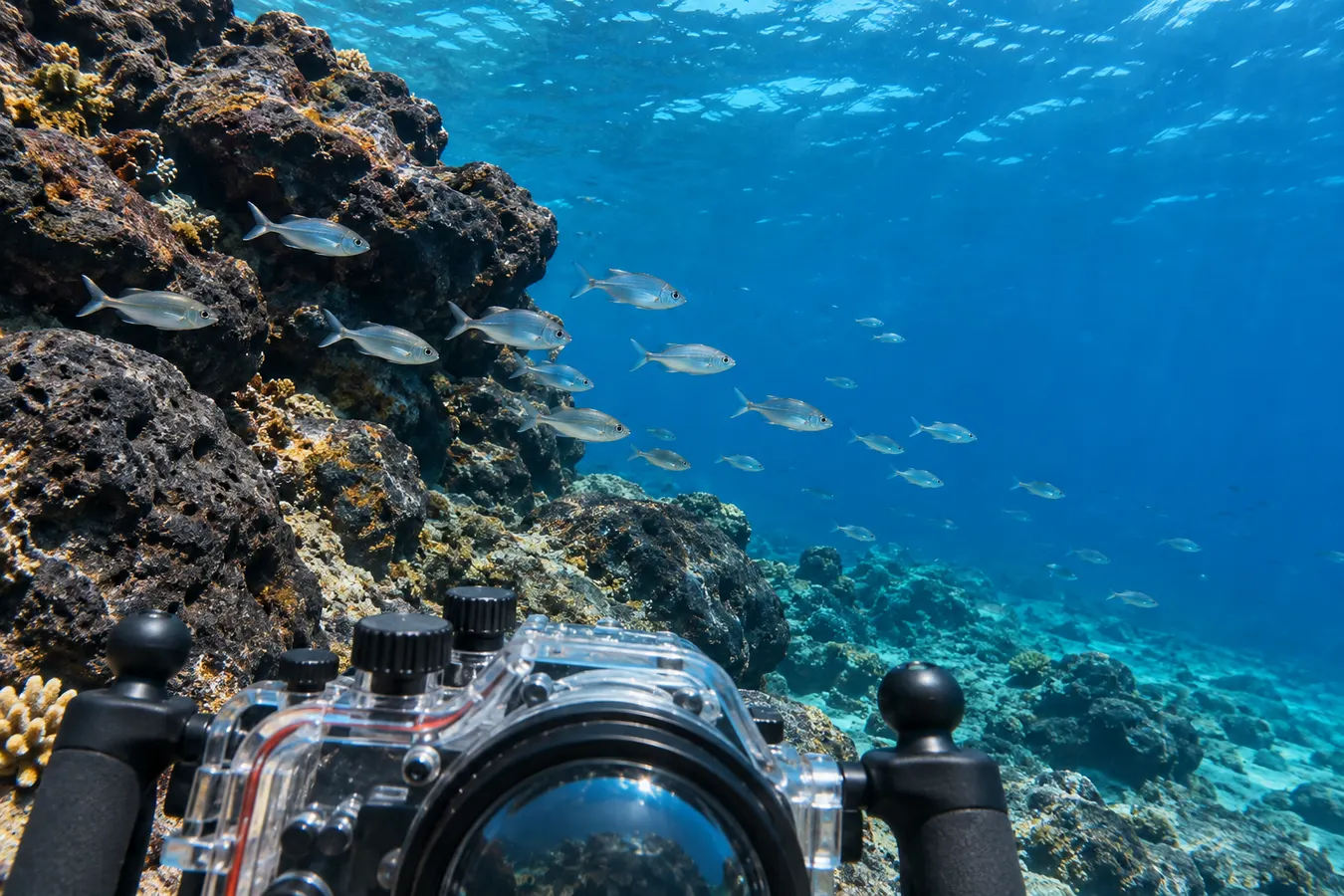
An underwater photograph of Tenerife might preserve a detail that memory retains imperfectly: a fish's colour, the contrast between black rocks and sand or a little cloud of silver fish. The camera allows you to look at these elements again once you are out of the water. It is an appealing accessory for snorkelling, provided it does not become the main reason for the decisions you take in the sea.
The challenge of taking pictures below the surface begins before you even switch on your camera. You cannot control the position of a wild animal, and the seabed is alive, even when it appears to consist of bare rock. Waves, wind and visibility also dictate what is possible. A photograph that requires changing an animal's behaviour, holding onto the bottom or leaving a safe area is one worth letting go.
Your personal equipment comes first
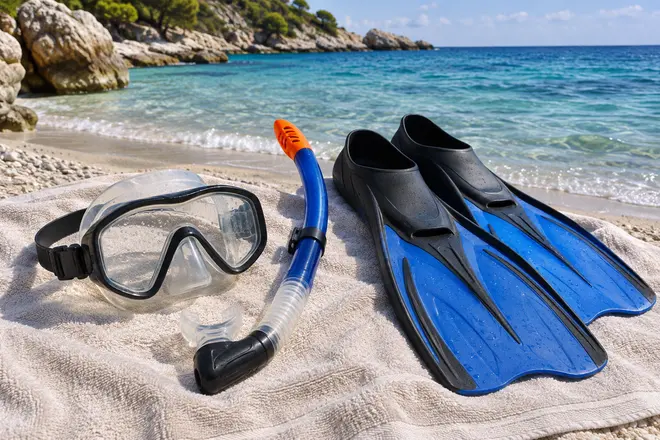
If you are just starting to snorkel, spend your initial practice sessions becoming familiar with your mask, snorkel and fins without carrying a camera. An accessory takes up space, diverts your attention and might make it difficult to communicate with your companion. While you are still learning, adding a device with buttons and settings might reduce your enjoyment of the water.
A controlled environment also lets you learn to use an underwater camera without having to solve problems while you are out in the ocean. Read its instructions, learn the basic controls and check the operation of its closing mechanism before entering the water.
In the sea, limit the amount of equipment you carry. A small camera designed for the intended use might be easier to manage than an array of bulky devices. Avoid loose cords and accessories that present entanglement risks, and if you are taking part in a guided activity, find out which accessories are suitable beforehand.
Remember that a camera is dispensable. Beach signs, awareness of boats and staying in contact with your companion take absolute priority. If you struggle to use the camera and maintain your orientation, put it away or bring your session to an end.
How light changes underwater
When light enters the sea, its visible composition changes. Certain wavelengths are attenuated more quickly than others, meaning rocks or fish that appear deeply coloured close to the surface might look bluer or greener at greater depths.
The objective of taking photographs during snorkelling should not be to compensate for this effect by moving closer and closer to an animal. Wider pictures show how a species lives within its surroundings. The light passing through the surface can also create interesting patterns on the rocks and sand.
When the surface moves, reflections change constantly. A scene that appeared unremarkable one moment might be lit differently seconds later. Make use of this variation from a safe position instead of moving towards a more complicated access point in search of a particular angle of light.
Related reading: Snorkelling equipment: what to choose for Tenerife.
Visibility also depends on particles suspended in the water. If the ocean is murky, you might enjoy taking pictures from land instead. Do not go farther offshore in the hope of finding clearer water, and do not continue if you are struggling to see your surroundings.
Scenes that tell a story about the seabed
There is no need to compose every frame around a single fish. A combination of elements can provide a better picture of the characteristics of Tenerife's coast.
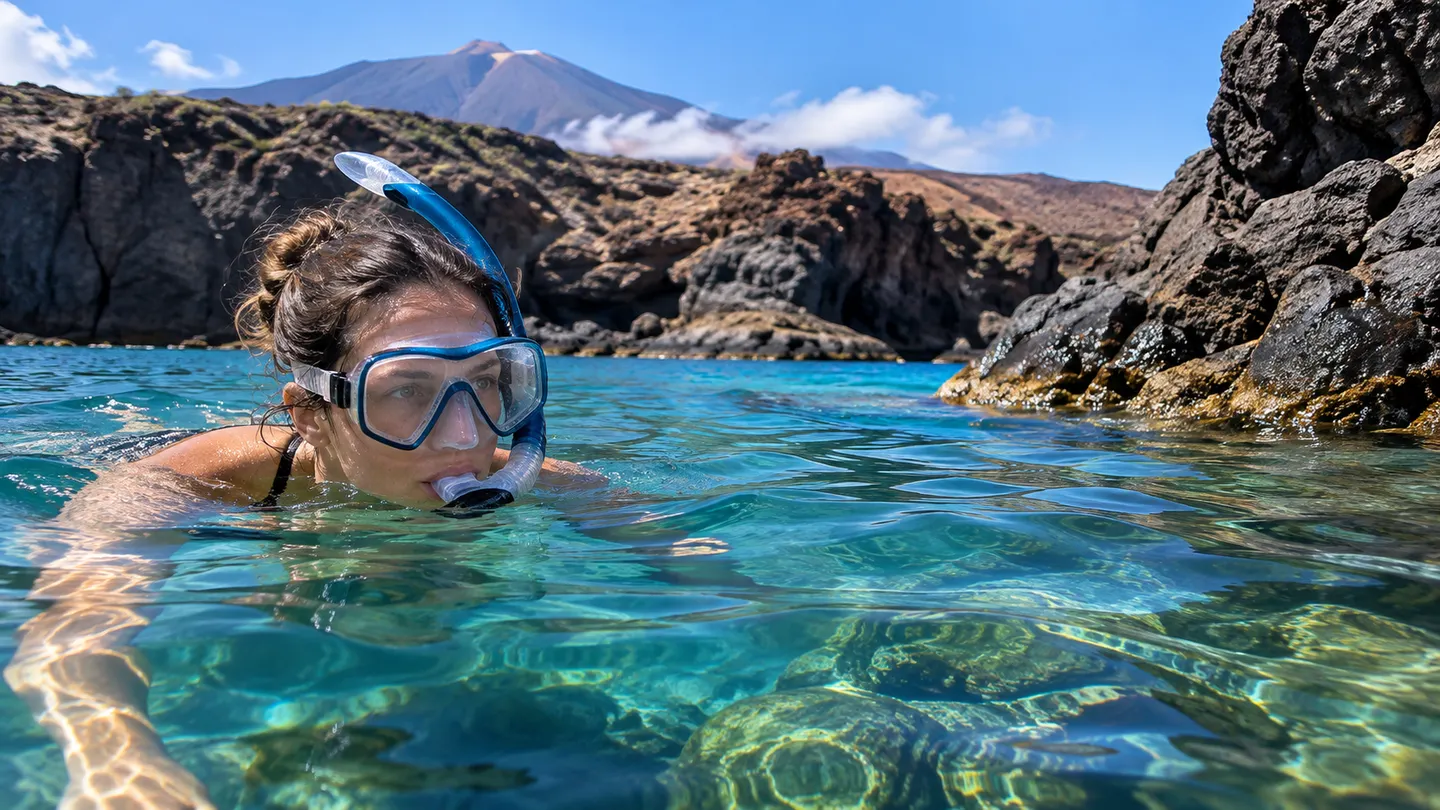
For example, a patch of pale sand beside dark volcanic rocks can show the transition between two substrates. A small shoal swimming overhead adds scale to the landscape. A reflection of the surface visible at the top of the frame helps show that the picture was taken close to the surface.
Underwater plants and algae offer all kinds of repeating patterns. You can photograph these textures from a distance without touching the bottom. If a photograph requires holding onto a rock, manoeuvring among living organisms or approaching somewhere from which it is difficult to exit, forget about it.
There are interesting subjects on the shore, too. Rockpools, viewed from a permitted point on land without risks from waves or falls, can help document the relationship between the substrate and the organisms that live on it. Do not take creatures out of pools or rearrange stones to compose a scene. The subject is more valuable in its original setting.
Photographing wildlife without pursuit
A marine turtle appearing in your field of view can make you want to move closer. The animal, however, needs to travel, breathe, feed and rest without obstructions. Do not follow it, surround it alongside other swimmers or try to position yourself in front of it to photograph its face. If it leaves the area, let it go.
Much the same applies to shoals of fish. Some groups change direction when they detect movement nearby. Do not try to provoke that behaviour to get a more dynamic photograph. Nor should you feed fish or any other animal in order to attract them towards the camera.
An octopus might use a crevice for shelter. If you see part of the animal, do not try to draw it out, shine a light persistently into the hole or lift any rocks. The opportunity to take a picture does not justify interfering with its rest or defences.
Consider whether your presence is changing the scene. An animal that moves away whenever you reposition the camera provides a clear indication that you should stop observing. Keep your distance and allow creatures to occupy their space.
Looking after the camera before and after swimming
The term water-resistant does not necessarily mean that a device is designed for prolonged use beneath the surface. Consult the manufacturer's specifications, depth limits and intended conditions of use. If your equipment depends on a housing, check its condition, the cleanliness of the seals and the instructions for checking its watertightness.
Make your preparations on land away from any sand that might stick to the seals. If you need to adjust something, leave the water at a safe exit. Do not open an equipment compartment while in the sea or spend time troubleshooting an electronic fault in an uncomfortable situation.
After the session, rinse your equipment in accordance with its maintenance instructions. Before removing a memory card, opening a compartment or connecting an accessory, follow the recommended drying procedure. Store the camera separately from equipment that might contain sand or water.
Editing to reflect your observations
When you look through your photographs, you might find the colours are slightly different from what you remember. You can make moderate adjustments to exposure or colour balance to recover details. If preparing a picture as a record of nature, avoid adding animals, changing their positions or altering the natural seabed.
A blurred image might still contain useful information. Instead of immediately deleting it, try to recognise the context: the type of substrate, the shape of the fish or whether it was alone or in a group. Do not make a confident species identification if the necessary features do not appear in the photograph.
Choose a small number of pictures to illustrate the variety of what you have seen. One view of the scenery, another of fish at a distance and perhaps a picture from land can tell the story better than lots of virtually identical shots. It is also worth avoiding sharing the precise locations of sensitive animals, particularly in places experiencing strong visitor pressure.
Leaving some time to look without a camera
Set aside part of the day to enjoy the water without trying to record every moment. Concentrating on a screen changes how you look around you. Without a camera, you can pay attention to sounds, changing light, colours and movements beyond the frame, while keeping in contact with your companion more easily.
Perhaps the most beautiful scene of your holiday will not make it into your album. That does not mean the moment was wasted. In responsible underwater photography, the best practice is to prioritise the animal's wellbeing, the condition of the seabed and your own safety over obtaining any particular image.
Explore next: Snorkelling in Tenerife.