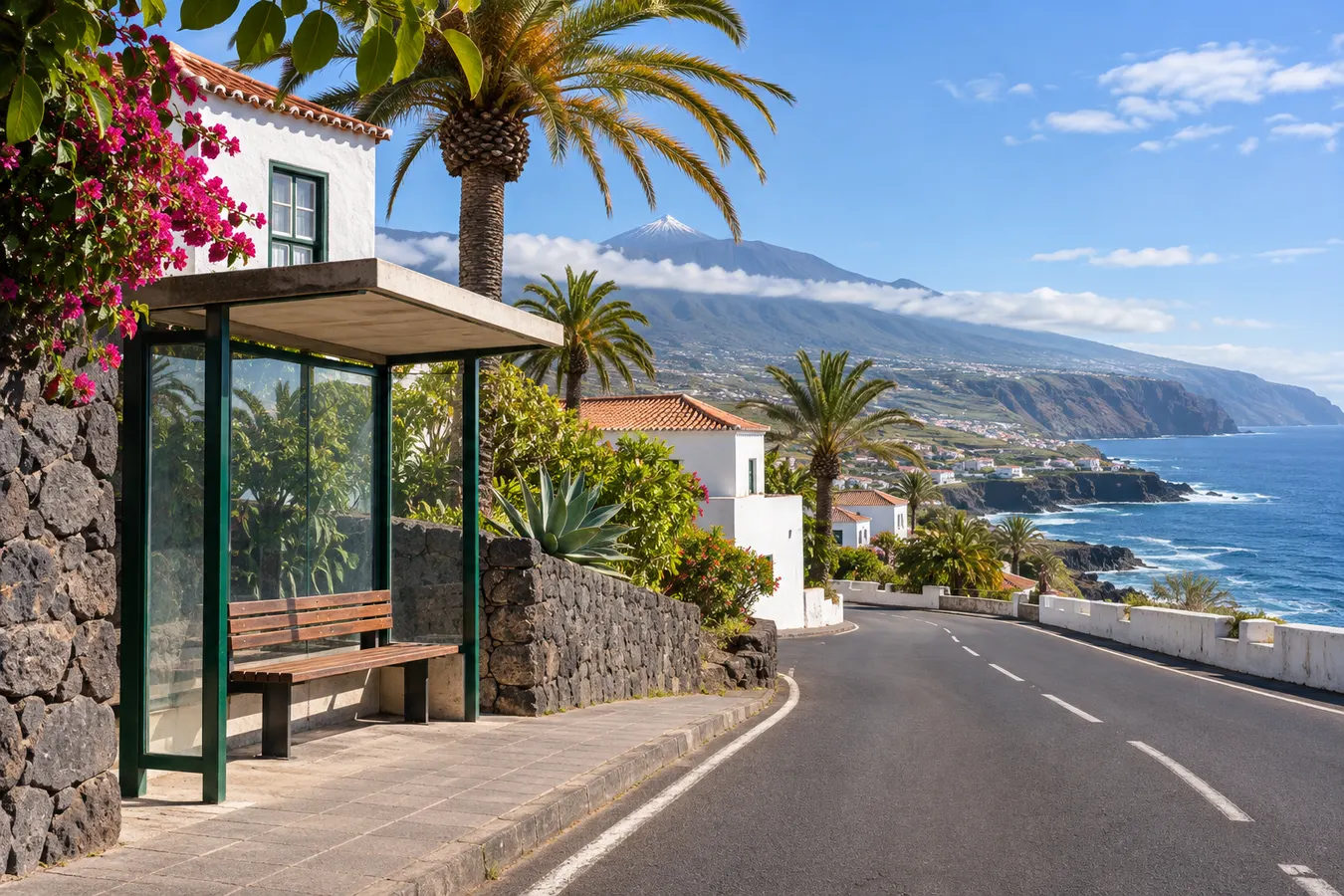
Doing without a car in Tenerife changes the rhythm of your holiday. You can enjoy a kayaking outing and reach certain mountain landscapes by public transport, but it is not realistic to include any destination on the island that happens to appeal to you. The easiest journeys tend to connect large settlements. To access particular walking trails, bus services may be infrequent, and there is a considerable difference between reaching a town and actually arriving at the start of a path.
The best way to organise the trip is to choose accommodation on the basis of the transport connections you are going to use most. It is less about collecting route numbers than understanding where to change buses, how long it takes to get to the stop from your room and what alternatives are available when the service finishes for the day.
Choosing a base for easy daily journeys
Los Cristianos offers an advantage for anyone wanting to combine beach days, water activities and short trips on foot. The bus station connects with various parts of the south and much of the town can be explored by walking. Costa Adeje is another possible base with important transport connections, although its size makes it necessary to pay close attention to the location of the accommodation. A property advertised in Costa Adeje could be a long way from the bus station despite both addresses bearing the same name.
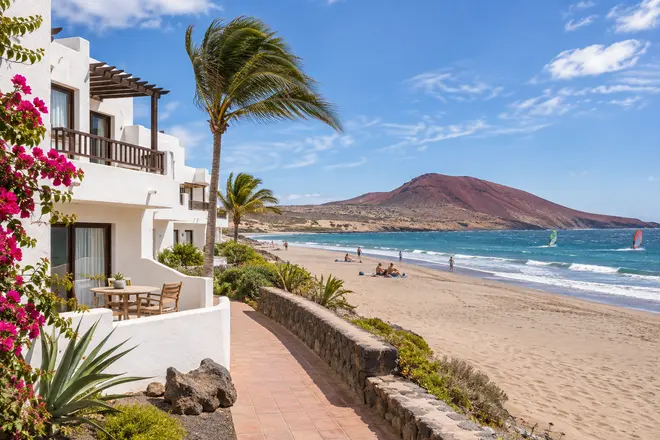
On the east coast, El Médano is an interesting place for a few days focused on the town itself, beaches and the landscape around Montaña Roja. If you would like to undertake activities in another municipality, investigate the transport connections. Route 470, for example, links El Médano to Los Cristianos via several southern settlements. It is a way of exploring that part of the coast with numerous stops, not a direct transfer for which the arrival time can be calculated just by looking at the distance.
In the north, Puerto de la Cruz has a bus station which is useful for journeys in the surrounding area. La Laguna and Santa Cruz, also connected to each other by tram, are useful locations if you are interested in urban centres, Anaga and different excursions in the north-east. If you only have a few days, it is better to settle on one area than to spend mornings and afternoons crossing the island.
From the airport to your accommodation
Tenerife has two airports. Before planning the journey, establish which one appears on your flight booking. Bus services link each airport with some of the main population centres. It will not always be possible to complete the journey using a single service. Your arrival time, the time needed to collect your bags and the service frequencies that day are all factors in the planning.
Some people prefer taking a taxi for the first and last journeys and using public transport for the remainder of the holiday. That is an option which allows you to choose flights at times less compatible with the bus network without abandoning the idea of a holiday without a hire car. To establish whether it makes sense, add that cost to your budget and do not assume that every journey on the island can be managed in the same way.
Related reading: Staying in El Médano: beaches, wind and nature walks.
Kayaking and snorkelling without your own car
To join a guided session, ask about the precise location of the meeting point and the time the group needs to be there. The last part of the journey may be a walk from a bus stop, so check the route in the clothes and equipment you will have with you. An activity advertised under the name of a town does not necessarily begin at its main bus station.
A light bag containing dry clothes, water, sun protection and essential personal items makes it easier to get around. It is not advisable to carry bulky equipment on public transport without knowing the permitted dimensions or luggage conditions. People with no experience in kayaking or snorkelling must learn about the requirements and have suitable equipment for the activity. Once at the coast, always follow the instructions of the people in charge of the session and respect restrictions on use of the shoreline.
When arranging a water activity it is important to keep an alternative day available. Having dedicated a considerable amount of time to travelling to a beach does not make unfavourable conditions suitable for paddling or entering the water. In Los Cristianos, Las Vistas or Costa Adeje, it is easy to arrange a walk if your session cannot take place. Before boarding the bus, it may be worth confirming that the activity is still going ahead.
Visiting Teide by bus
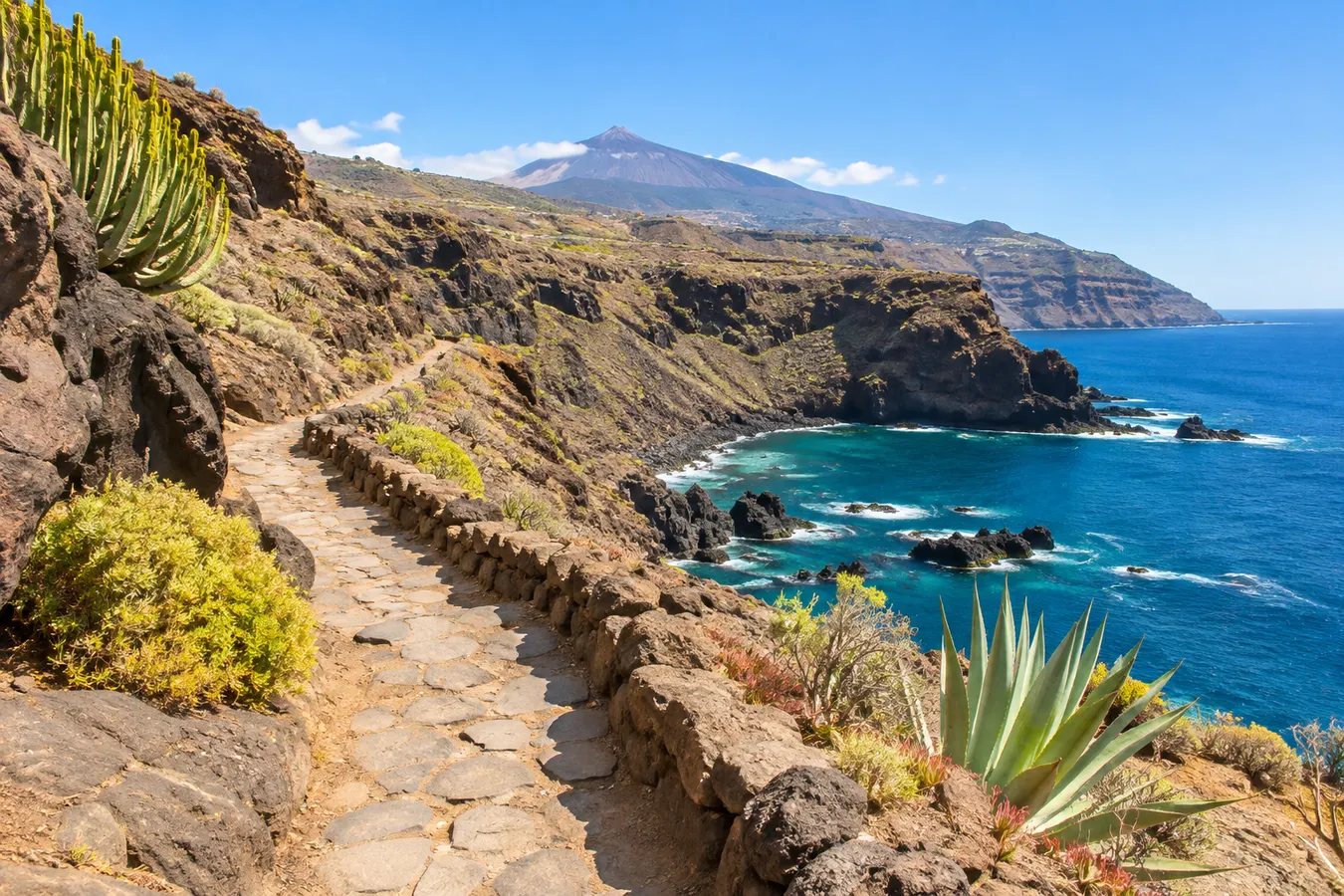
The national park has dedicated bus connections from different parts of the island. Route 342 has linked Costa Adeje and Los Cristianos with the park, while the 348 climbs from Puerto de la Cruz and La Orotava. The current routes and times should be checked before visiting. They do not have the frequency typical of certain urban routes, and missing the return service can cause considerable problems.
First establish which stop is near the place you want to visit. If a bus drops passengers off in one part of the national park, it does not mean that every other location is within a comfortable walking distance. High elevation, sunshine, possible restrictions and gradients greatly influence the duration of any walk.
There is nothing wrong with visiting a couple of places in the volcanic landscape without setting out on a long hike. Do not try to reach a summit or link several different paths on a tight transport timetable. Take water, sufficient food and clothes suitable for cold temperatures and wind, even if you set out from a warm coastal town.
Exploring Anaga by public transport
One way to approach the massif is to travel from La Laguna towards the area around Cruz del Carmen, served by lines which continue to small mountain villages. From Santa Cruz there are transport connections to the Taganana side of the mountains. Routes 275 and 946 are examples of services that have made these journeys possible, although it is vital to investigate any changes.
For a short walk, look for a route which allows you to return to the same bus stop. Walks ending in a different village require careful calculations of the return journey, plenty of time to spare and a check that there really is a service in that direction. Missing the last bus is no small inconvenience in a rural area.
Check permitted trails, restrictions on numbers and possible closures separately. The fact that a bus route is still operating does not necessarily mean that the intended path is open to visitors. In fog, rain or strong winds, it may be preferable to spend the day in La Laguna or Santa Cruz instead.
Tips for getting around on foot and combining transport connections
When planning the day, note down the names of the stops, the return times and an alternative. It can be practical to save the information on your phone so you can consult it without relying on mobile reception. Make sure you have sufficient battery charge, as well as water and food for the journeys. If you expect to return from a walk late in the day, set a turnaround time well before the departure of the bus.
The coastal towns have several pleasant pedestrian connections, but it is not sensible to extend a walk along the hard shoulder of a main road when the footpath ends. Maps can show a short distance without explaining whether there is a pavement. To choose sensible routes, check the available public paths and take hills into account.
Travelling without a car can be a lovely way to get to know Tenerife when you create an itinerary on the appropriate scale. With a good base and a few well-chosen excursions, there is still time left to contemplate the sea, wander through streets and rest after paddling. It is a style of travel in which flexibility is every bit as valuable as punctuality.
Explore next: Where to stay in Tenerife for active holidays.